


Moving up the Stack: The Strategic Case for a CRE Super Nucleus

By Stuart in Moving up the Stack
· 15 views
In a world where organisations are now building decision-making models that respond to real-time conditions, and agentic AI is becoming the operating system of modern industry, a strong case exists to move the CRE function ‘up the stack’ — away from administrative throughput and toward the apex of enterprise value creation: strategic intelligence, predictive decisioning, and board-level influence.
This article sets out the five core capabilities of tomorrow’s CRE Super Nucleus, the organisational consequences of the transition and the compounding logic that makes starting these transformation initiatives now more valuable than risk of starting late.
01. The Stack Problem — Where CRE Sits Today
Most CRE functions concentrate their resource and headcount at the lower layers of the enterprise value hierarchy: administering leases, processing invoices, coordinating maintenance requests, and managing periodic portfolio reviews. Whilst consequential, these activities are not where strategic value is created, however they are precisely where AI automation should start.
As a useful rule of thumb: tasks lend themselves to automation where their outputs can be reliably checked at scale. Lease abstraction, critical date monitoring, invoice validation, energy reporting (all meet this test!).
02. The Super Nucleus — Five Core Capabilities
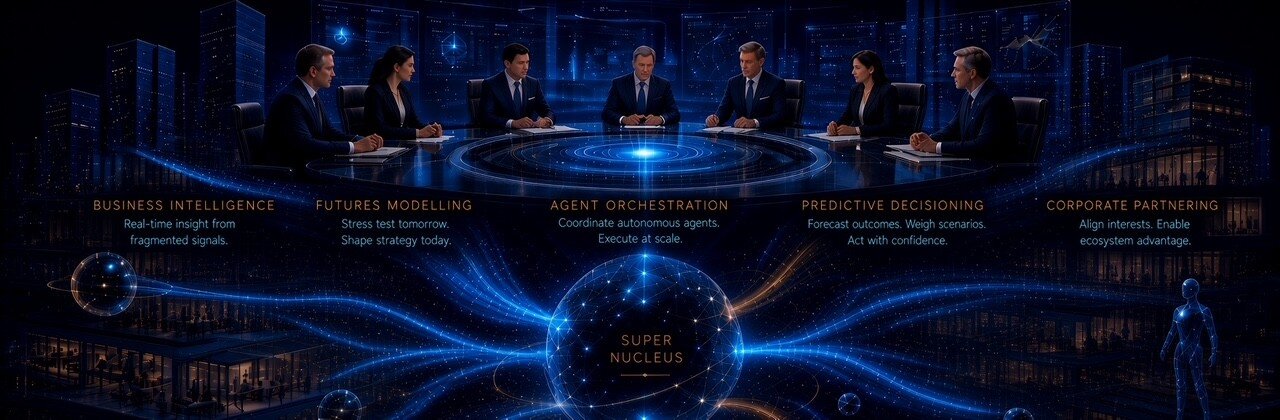
The future CRE function is not a property management department. It is an intelligence and decisioning nucleus at the heart of corporate operations, an integrating layer connecting physical asset decisions to business strategy, operating at the top of the value stack with a fleet of AI agents executing the operational layer of CRE.
The ‘Super Nucleus’ consists of five core capabilities:
Business Intelligence
In a Super Nucleus model, the CRE function synthesises occupancy signals, workforce movement, and financial performance in real time, generating strategic recommendations continuously, not on request. CRE ceases to be a function that reports on what happened and becomes one that shapes what happens next. The consequence is a direct migration from cost-centre status to strategic intelligence function, with measurable influence on the P&L rather than a line item within it.
Energy and utility reporting is furthest along this path today: JLL’s 2025 global technology survey found it the most mature AI use case in corporate real estate, with measurable near-term returns already visible, while portfolio-level “intelligence” of the kind described here remains an emerging capability for most functions (JLL, Reality Check, 2025).
Predictive Decisioning
AI-driven models assess space requirements before business units articulate them, evaluate procurement options against live market conditions, and surface capital investment choices ranked by risk and return. Data generated across the portfolio feeds continuously into these models, sharpening their accuracy with every new data point. This is the capability that transforms CRE data from a reporting input into a board-level executive function feeding financial/ESG disclosures, workforce planning, and financial forecasting simultaneously.
McKinsey’s 2026 analysis of agentic AI in real estate found renewal decisions redesigned around live market data produced 3 to 7 percent higher renewal rates than periodic, backward-looking reviews (McKinsey & Company, 2026) — a modest illustration of what “predictive” looks like before it reaches board-level capital allocation.
Agent Orchestration
The future CRE Super Nucleus does not execute CRE operations directly. It governs a fleet of AI agents that do. Lease abstraction, critical date management, facilities monitoring, market intelligence, carbon tracking, procurement, and compliance monitoring are each assigned to a specialist agent operating continuously and autonomously within defined parameters. The human CRE team manages this fleet — setting policy, validating outputs, handling exceptions, and improving the models — rather than performing the underlying tasks themselves. The team becomes leaner and more senior; the operational throughput grows rather than shrinks.
This is the capability furthest from today’s reality for most functions. It depends on the orchestration discipline this series returns to directly in Article C and Article D — without it, a fleet of independently deployed agents is closer to a collection of point tools than a governed workforce.
Corporate Partnering
Armed with real-time intelligence and predictive models, the Head of CRE evolves into a direct strategic partner to the CFO, CHRO, and CSO rather than a service provider responding to their requests — a shift some organisations are already signalling through title changes such as Chief Workplace & Intelligence Officer, though the substance of the role matters more than the label. Portfolio decisions are connected explicitly to workforce strategy, capital allocation, and sustainability commitments. CRE is no longer briefed after the strategic decisions are made; it is in the room where they are made, with the data to shape them.
Futures Modelling
The Super Nucleus runs continuous scenario analysis across the variables that will determine the portfolio’s long-term fitness. Hybrid work trajectories, geopolitical risk to occupied markets, energy transition timelines, and net-zero pathway modelling are not annual exercises in this model — they are live inputs that the Super Nucleus monitors and responds to as conditions evolve. Physical-world data generated by the CRE function feeds directly into the enterprise-wide AI model layer, creating an institutional intelligence that compounds over time.
Carbon and energy modelling is the most established starting point for this capability in practice, since utility and emissions data are already structured and continuously generated. Scenario modelling for geopolitical or hybrid-work risk is a genuinely emerging application — worth building toward, but not yet running as a live, continuously updating model in most CRE functions today.
03. The Compounding Loop — Why Proprietary Intelligence Matters
As AI transitions from passive answer-generation to active task completion, a new class of resource emerges: the digital workforce. AI agents are capable of planning, executing, and evaluating complex workflows with genuine autonomy — without the cost and scaling constraints that attach to human headcount.
The more profound implication for CRE is not the cost saving. It is the learning loop. Organisations that deploy agents on proprietary data build a continuously improving intelligence system: agents generate operational data, that data trains models, models produce smarter agents. Each cycle compounds. Organisations that rent intelligence from third-party platforms receive generalised outputs trained on aggregated market data, which whilst useful, is not calibrated to the specific context of their portfolio, workforce, or their strategy. The compounding case for starting early is real.
“As agentic systems create data and experiences, we memorise what is really good. That data comes all the way back to pre-training. We refine it in post-training, enhance it at test time, then the agentic systems put it to the industry. This loop goes on and on.”
— Jensen Huang, Lex Fridman Podcast #494, March 2026
04. The Organisational Consequences
A shift to a Super Nucleus model carries significant implications for how tomorrow’s CRE function is structured, resourced and positioned within the enterprise. The following changes follow logically from the five capabilities described above:
• CRE migrates from a cost-centre function to a strategic intelligence function with direct P&L influence
• The Head of CRE becomes Chief Workplace & Intelligence Officer, with a seat at the Executive Committee
• CRE data becomes a board-level asset, feeding financial/ESG reporting, workforce planning, and financial forecasting simultaneously
• The CRE team governs a fleet of in-house AI agents alongside a leaner, more senior human operation
• Physical-world data generated by the CRE function feeds into the enterprise-wide AI model layer, creating compounding institutional intelligence
The question for today’s property, workplace and facilities leaders is not whether this transition will happen, it is whether their function will lead it or be reshaped by it. The tools to begin are available now.
Part three of the Transcending Real Estate series will look at the work of redesigning CRE workflows for this new model.
References
Jensen Huang, Lex Fridman Podcast #494, March 2026.
McKinsey & Company, “How agentic AI can reshape real estate’s operating model,” March 2026.
JLL, “Reality check: The true pace and payoffs of AI adoption in corporate real estate,” Global Real Estate Technology Survey 2025, October 2025.
Recommended Comments